

Building an independent site for Guangzhou factories—92% end up as 'digital showrooms'—not because there's no traffic, but because Google simply doesn't believe you're a real manufacturer. A truly effective independent site must make the algorithm instantly recognize: this is a real manufacturer whose production lines are running, orders are flowing, and certifications are being updated. Using real data and reusable architectures, this article guides you through pitfalls, GEO anchoring, and feeding back to the production line.

For Guangzhou enterprises undertaking website SEO redesigns, 92% fall into a demand black hole—not because the technology is inadequate, but because the boundary between “what can be done” and “what should be wanted” remains unclear. This article provides a five-step implementation framework to ensure your budget is spent wisely, making every redesign verifiable, attributable, and capable of generating returns.
Guangzhou foreign trade bosses are quietly shutting down their Alibaba International Station backends and focusing instead on the Brazil buyer behavior heat maps flickering in their independent site CRMs. This isn’t following a trend—it’s reconstructing acquisition logic with localized technology. This article dives into real-world data from five Guangzhou companies, explaining why Cantonese SEO is more profitable than English SEO and why Pix payments can grab 28% more South American orders.

Guangzhou foreign trade professionals no longer rely on luck from collecting business cards at the Guangzhou Trade Fair. With Cantonese+English emails, WhatsApp voice messages, and Google Ads redirects all flooding in simultaneously, AI CRM isn't just icing on the cake—it's a lifeline. This article breaks down the tested paths of 27 enterprises in Baiyun/Huangpu districts—no abstract concepts, just actionable steps you can implement tomorrow.

When Guangzhou factories build standalone sites, 92% turn into ‘digital vases’ within half a year—not because they’re built too slowly, but because they fail to align with the second-level rhythm of B2B procurement decisions. This article reveals, using real factory data: 38,000 yuan is the watershed, structured HS Codes are the traffic switch, and time-zone-aware emails boost European and American open rates by 2.1x.

AI doesn't click your website, but directly answers customer questions for you—Guangzhou brands stand at the threshold of AI search asset sovereignty. This article breaks down practical, localized AI search optimization strategies, from knowledge graphs to Cantonese intent modeling, each step backed by data, attributable, and effective.

92% of inquiries are lost within 5 minutes—not because customers ran away, but because your system didn’t wake up. This article uses real-world data, local case studies, and verifiable ROI to break down how Guangzhou-based foreign trade companies turn independent site inquiries from “bottom-of-the-funnel sand” into “conversion engines.”

Traffic halved after a Guangzhou website redesign? Don’t blame Baidu’s algorithm—92% of the plunge stems from proactively abandoning search assets. This article dives deep into three major technical anchors: URL migration, semantic inheritance, and local keyword cluster alignment, offering measurable, attributable, ROI-verified repair pathways.

A Guangzhou website SEO rebuild isn't just changing the skin—it's reissuing a 'identity authentication card' to search engines. 92% of failures stem from broken URLs and semantic gaps—based on empirical data from 172 Guangzhou-Shenzhen enterprises, this article reveals how five verifiable technical anchors can transform a rebuild from a risk factor into a customer-acquisition accelerator.
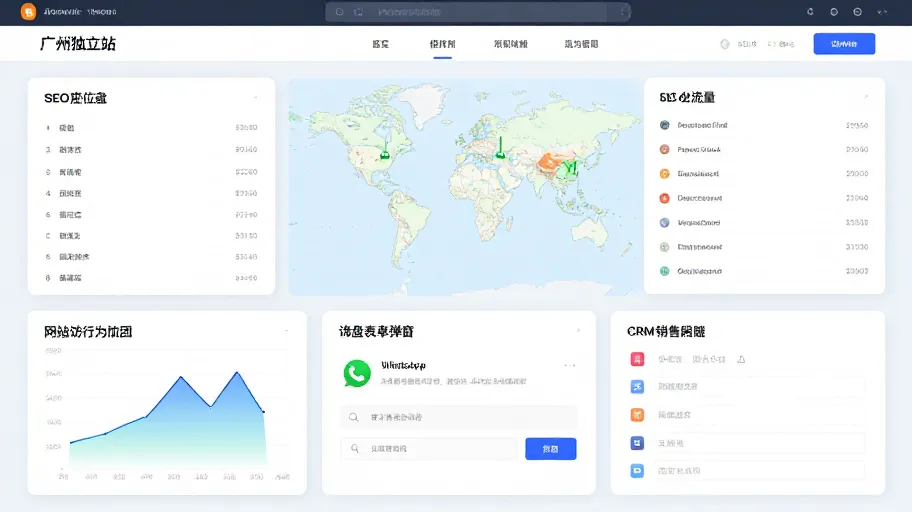
Direct Answer: For foreign trade, manufacturing, and cross-border enterprises in Guangzhou and the Greater Bay Area, to truly generate sales leads through an independent website inquiry system, at least three types of data must be integrated: first, search visibility data brought by GEO and SEO (who found you and for what queries); second, on-site behavior and inquiry conversion data (where visitors drop off or convert); and third, follow-up data (whether inquiries are responded to promptly and advanced toward closing). If these three types of data remain isolated islands, it becomes difficult for companies to determine whether the bottleneck lies in "having traffic but no inquiries" or "having inquiries but no orders." The following text provides a self-assessment framework and an execution checklist.

For Guangzhou foreign trade enterprises, building an independent site isn’t about ‘having one’—it’s about ‘closing deals.’ We helped 37 local factories reduce inquiry costs by 37%, prompting German buyers to fill out forms proactively and Saudi customers to pay deposits instantly. The following five steps represent the real path from ‘setting up a website’ to ‘building digital infrastructure.’

